
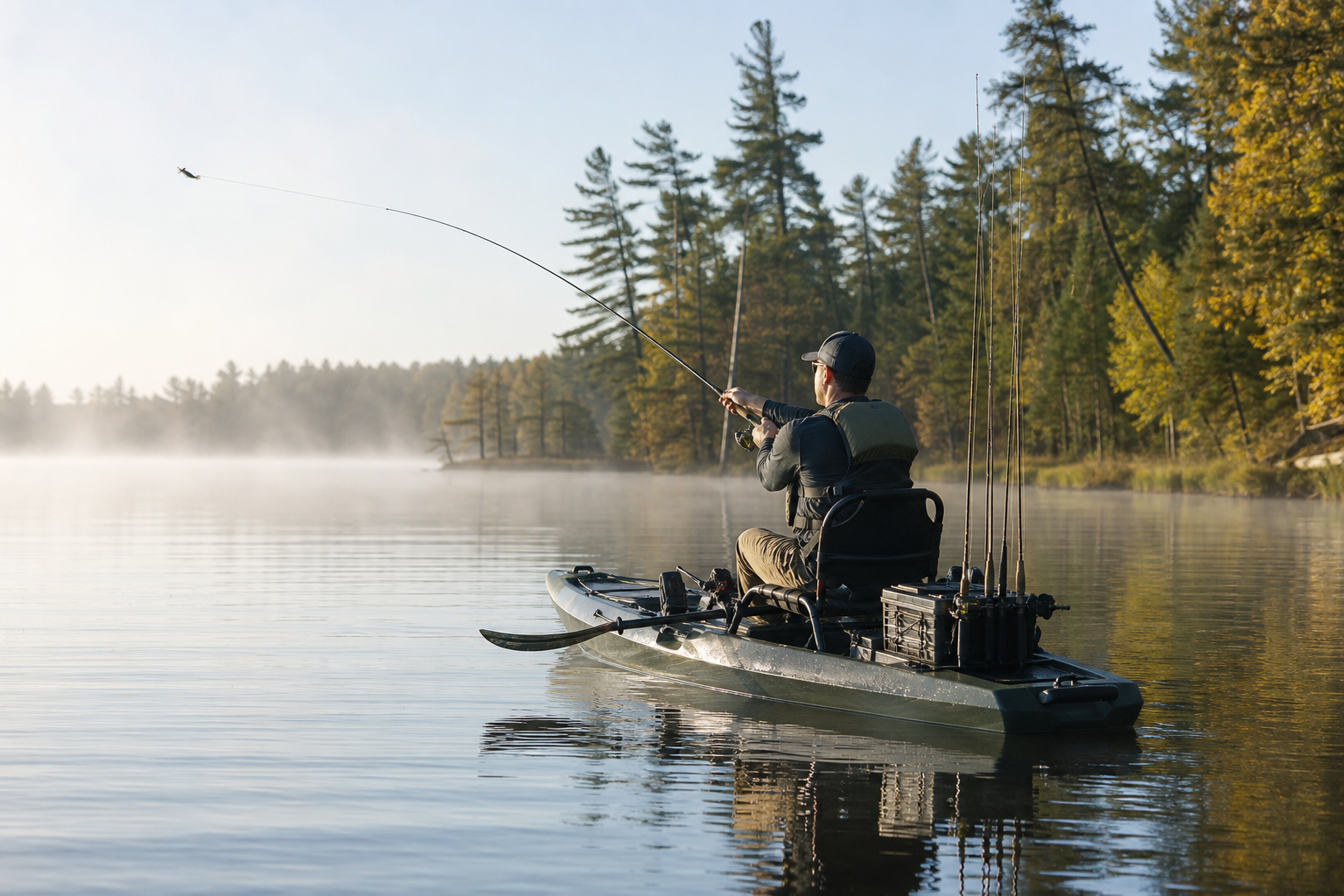
Bonafide PWR129 Review: A Kayak Built for Motors
At more than 100 lb in Bonafide’s fitted rigged configuration, the PWR129 stops being a casual paddle kayak before a motor or battery enters the equation. That weight reveals its priorities: this is a broad, highly configurable fishing platform for anglers who value stability, storage and electric propulsion more than easy carrying or efficient long-distance paddling.
Evidence note: This review combines Jukka’s hands-on use of the PWR129 with published specifications and warranty information. Read Nordwai’s Editorial Standards.
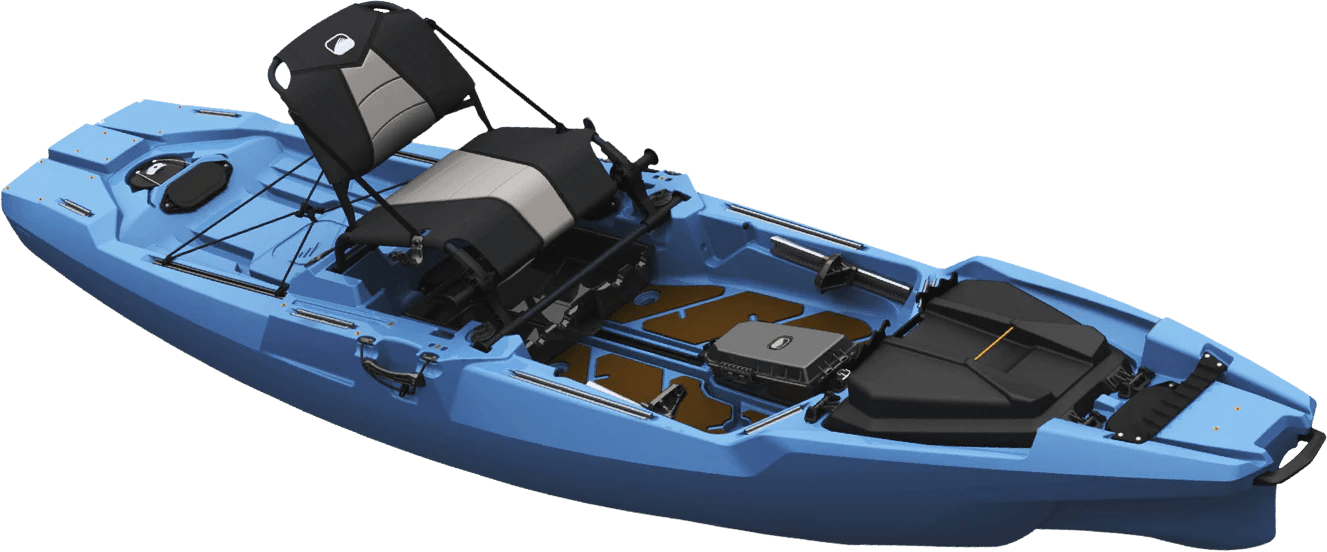
Nordwai has handled, transported and fished from the PWR129, including installing a bow-mounted motor. Those first-hand observations inform the comments on stability, seating, storage and transport, while published sources supply the specifications and warranty details.
The PWR129 specifications that matter on the water
The manufacturer’s specifications describe a 12 ft 9 in (389 cm) sit-on-top with a 35 in (89 cm) beam and hybrid catamaran-style hull. The width, elevated frame seat and open standing area create a spacious fishing position, while the storage and mounting provisions accommodate more elaborate builds than a conventional paddle kayak.
| Specification | Bonafide PWR129 | Why it matters |
| Length | 12 ft 9 in (389 cm) | Provides room for a broad deck, substantial storage and motor installations |
| Width | 35 in (89 cm) | Favours stability over effortless paddling |
| Depth | 16 in (40.6 cm) | Contributes to the high-volume hull; Bonafide’s published metric conversion is inconsistent, so the inch figure is used as the source measurement |
| Fitted hull weight | 78 lb (35 kg) | Already substantial for solo lifting |
| Fitted rigged weight | 102 lb (46 kg) | Transport planning is essential before adding propulsion |
| Maximum capacity | 500 lb (227 kg) | Includes the kayak, paddler and equipment combined |
| Standing deck | 22 x 30 in (56 x 76 cm) | Gives the angler a defined area for standing and casting |
| Internal hatch storage | About 30 US gal (114 litres) | Useful for bulky fishing or camping equipment |
| Stern well | 21 x 25 in (53 x 64 cm) | Room for a crate, dry bag or battery arrangement |
| Under-seat drawer | 16 x 18 in (41 x 46 cm) | Keeps frequently used tackle within reach |
Stable enough for standing, but sensitive to loading
For a larger paddler, the PWR129 provides a reassuring platform. Nordwai found it stable both seated and standing, with enough deck room to change position without feeling confined. That confidence is valuable for anglers who cast actively, reach for several rods or carry more equipment than a stripped-back paddle setup permits.
Stability still depends on the paddler, loading and conditions. Battery position, equipment distribution, wind, waves and current can affect trim and handling. The 500 lb (227 kg) capacity is not a promise of identical behaviour at every load, nor does it make the kayak capsize-proof.
The high/low frame seat is comfortable and provides a useful fishing position. For longer sessions, Nordwai’s tester recommends extra cushioning beneath the backside and behind the back. A purpose-made kayak cushion may be worthwhile for full fishing days.
Designed around motors rather than adapted to accept one
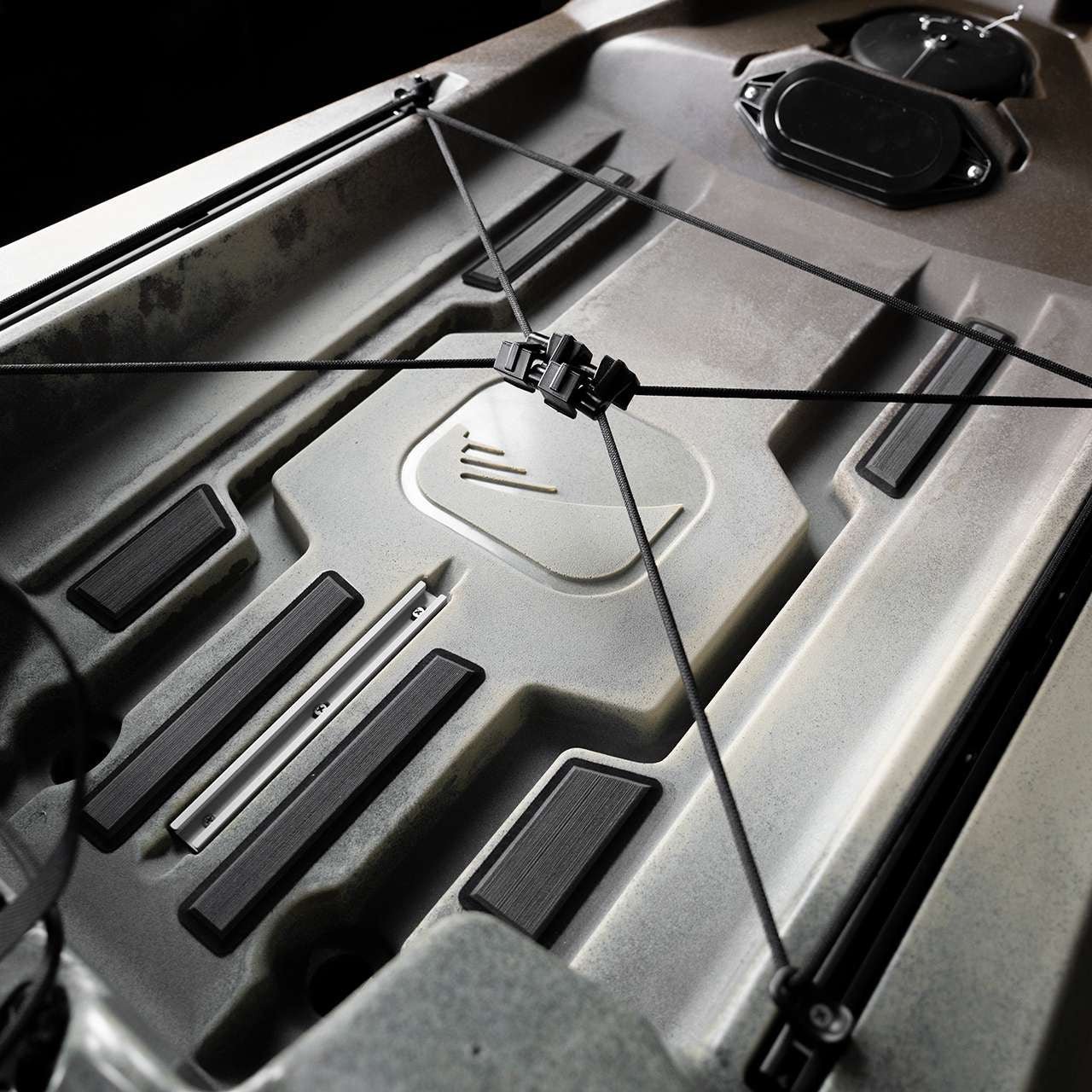
The PWR129’s defining feature is not a motor included as standard, but the infrastructure for adding propulsion. Bonafide provides bow and stern motorisation provisions, five gasketed PowerLink access ports, dedicated battery and storage spaces, 26 insert-mount points and ten gear-track locations totalling 128 in (325 cm). Buyers should still check the contents of any specific dealer package.
Nordwai found a bow-mounted motor straightforward to install, with useful plates and connection options positioned around the kayak. The replaceable PowerLink plates can be drilled for cables and fittings, avoiding holes directly through the main hull. It is therefore better described as hull-conscious rigging than completely drill-free installation.
A simple installation and a sophisticated powered system are different projects. A specialist PWR129 build documented by Kayak Angler combined two motors, multiple batteries and electronics, but required mechanical work, component planning and repeated trials. The hull makes that complexity more manageable; it does not remove it.
Build the system in stages. Fit the steering and motor first, then check deployment clearance and cable movement. Add the battery and test trim before installing sonar, tackle storage and other accessories.
The foot-controlled rudder earns its place
The integrated retractable Springblade rudder is controlled by the feet, leaving both hands available for paddling, casting or managing a fish. It can also provide a useful steering interface in a motorised configuration, depending on how the propulsion system is arranged.
Without a motor, the PWR129 can still be paddled. Nordwai found that entirely achievable, although longer distances could become fatiguing. The broad hull, elevated fishing position and substantial weight favour stability and payload rather than the efficient glide of a narrower touring hull.
This compromise matters most when the route requires sustained paddling. A short journey from the launch to a fishing area is less demanding, while repeated crossings, current or a headwind may expose the extra effort more quickly.
Storage suited to fishing trips that become camping trips
The large bow hatch provides approximately 30 US gal (114 litres), or 4 cu ft, of internal capacity. Nordwai found ample room there and in the stern section for fishing equipment or camping gear. The open rear well also allows the load to be arranged around a crate, dry bag or battery setup.
The under-seat “Junk Drawer” keeps smaller, frequently used items within reach. It is a practical place for compact tackle and tools that might otherwise move around the deck.
Numerous tracks and inserts allow rod holders, camera arms, electronics and tool storage to be arranged for different techniques. There is little reason to fill every available rail immediately. Each accessory adds weight or another potential line-catching projection, so it is sensible to refine the layout over several short trips.
The 500 lb capacity needs careful arithmetic
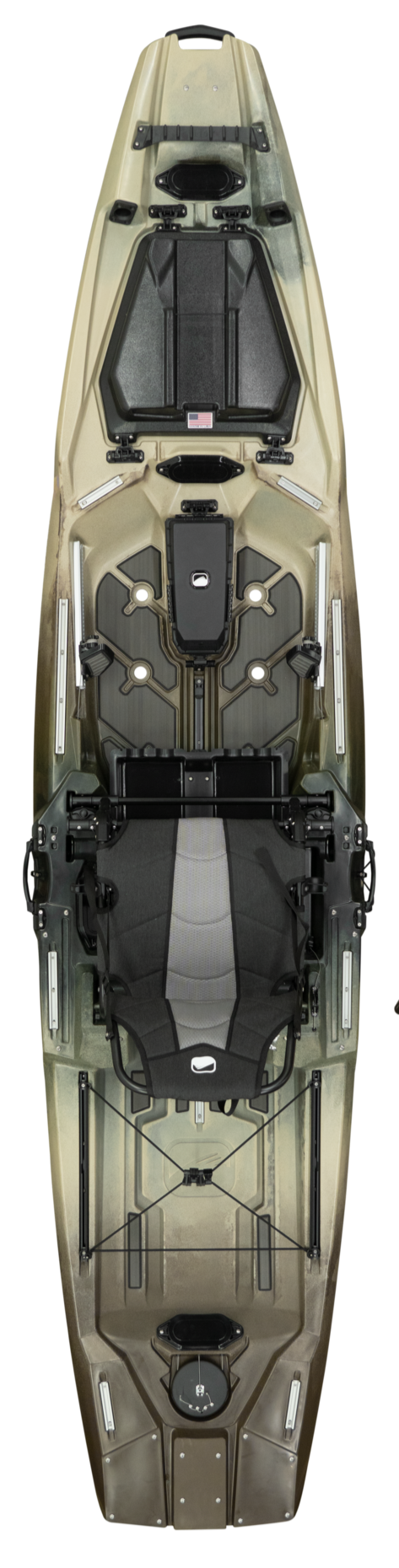
Bonafide specifies that maximum capacity includes the kayak, paddler and gear combined. Under that accounting, the listed fitted rigged configuration leaves 398 lb (181 kg) for the angler and everything subsequently added. The motor, mount, battery, fish finder, tackle, anchor, clothing, food, water and safety equipment must all fit within that allowance.
That provides useful scope, but powered-kayak weight accumulates quickly. A larger angler considering one or more batteries should create a complete written weight budget before buying components. Remaining below the headline limit can also leave more flexibility to adjust trim rather than producing a system that is technically within capacity but awkward to handle.
Transport is the first problem to solve, not the last
Nordwai has carried the PWR129 on the roof of a Škoda Octavia estate, so a trailer was not necessary for that vehicle and setup. Manoeuvring the kayak was nevertheless heavy work, particularly when moving it alone between storage, vehicle and water.
Before attempting a similar arrangement, check the vehicle manufacturer’s roof-load limit, the roof-rack rating and the weight of the bars. Being physically able to lift the kayak onto a car does not establish that the roof system is approved for the load. A suitable loading aid or help from a second person can make the process more controlled.
Once motors and batteries are added, transporting the kayak fully assembled becomes less attractive. Remove heavy components before lifting and use a cart suited to the hull and launch surface. A trailer may be sensible for frequent use, but Bonafide’s warranty exclusions make correct support and restraint important: improper transport, ratchet-strap damage and winching the hull onto a trailer are among the issues identified in its published terms.
PWR129 or PWR129 PRO?
The PWR129 PRO is a variant centred on a swivel Tempress seat rather than a replacement name for the standard kayak. It appears to retain the underlying PWR129 hull specifications, but buyers should confirm the seat, frame and included equipment on the actual dealer listing because packages can differ.
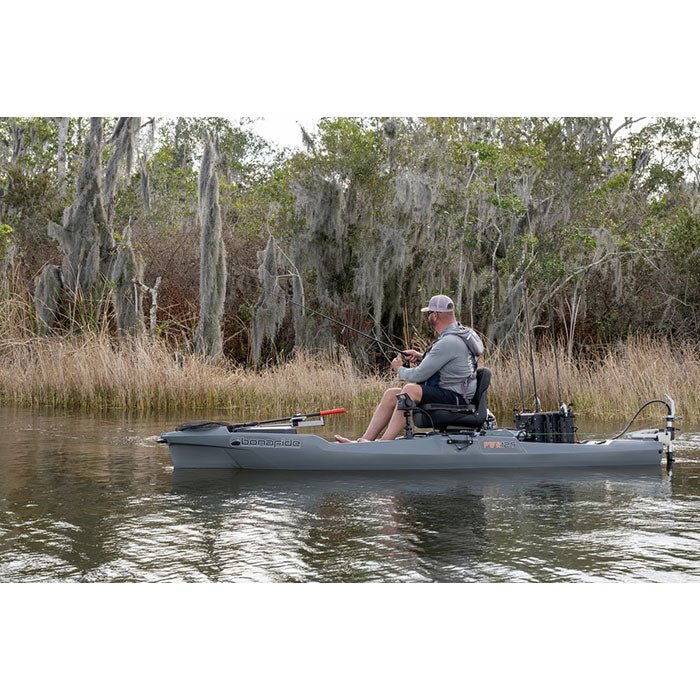
A swivel seat may make it easier to turn towards stern storage, change fishing angles or enter from the side. It also introduces another moving assembly to the seating system. Anglers satisfied with a conventional high/low frame seat may prefer the standard PWR129 and direct their budget towards propulsion, transport equipment or electronics.
Bonafide also lists a PWR PRO seat upgrade kit. Confirm compatibility and total cost before assuming that upgrading later offers better value than buying the PRO configuration initially.
Who will get the most from the PWR129?
The PWR129 suits an angler who carries substantial tackle, wants seated and standing stability, and expects to use an electric motor or extensive electronics. It also has appeal for fishing-and-camping trips where dry bags, shelter, food and extra clothing would overwhelm a smaller deck.
It is less convincing for someone whose priorities are low weight and simple paddling. Think carefully before choosing it if you:
- regularly carry a kayak down steep banks or across soft ground alone;
- primarily want an efficient paddle craft for covering distance;
- have limited storage space at home;
- want a complete powered package without planning mounts, wiring and batteries;
- expect the hull purchase to represent the full cost of the system.
A demo is worthwhile if one is available. Seat height, standing confidence and paddle effort vary with body size, mobility and balance in ways that a specification sheet cannot settle.
Motorisation changes the legal and safety picture
Rules for powered kayaks vary by jurisdiction and waterway. In the United States, the US Coast Guard’s federal boating guide explains that a craft fitted with propulsion machinery generally must be registered in its state of principal use and is treated as power-driven for navigation-light rules. State and local requirements may go further.
Elsewhere, check the relevant maritime, transport or waterway authority before launching a motorised build. Registration, identification, lighting and access requirements are not internationally uniform. Carry a correctly sized wearable PFD approved for the jurisdiction and wear it while underway.
New owners should also register the kayak promptly. Bonafide requests product registration within 14 days and publishes a limited lifetime provision for manufacturing defects in the hull for the original retail customer, five years for qualifying normal-wear issues and one year for components. Those provisions remain subject to the warranty’s conditions and exclusions.
Editor’s judgement
The PWR129 is a specialist purchase rather than a general-purpose paddle kayak. It makes the most sense when its weight and rigging requirements are accepted from the outset and the buyer genuinely intends to use its stability, storage and motorisation provisions.